
Toy Toolbox: How to Use the Critter Clinic in Multiple Ways
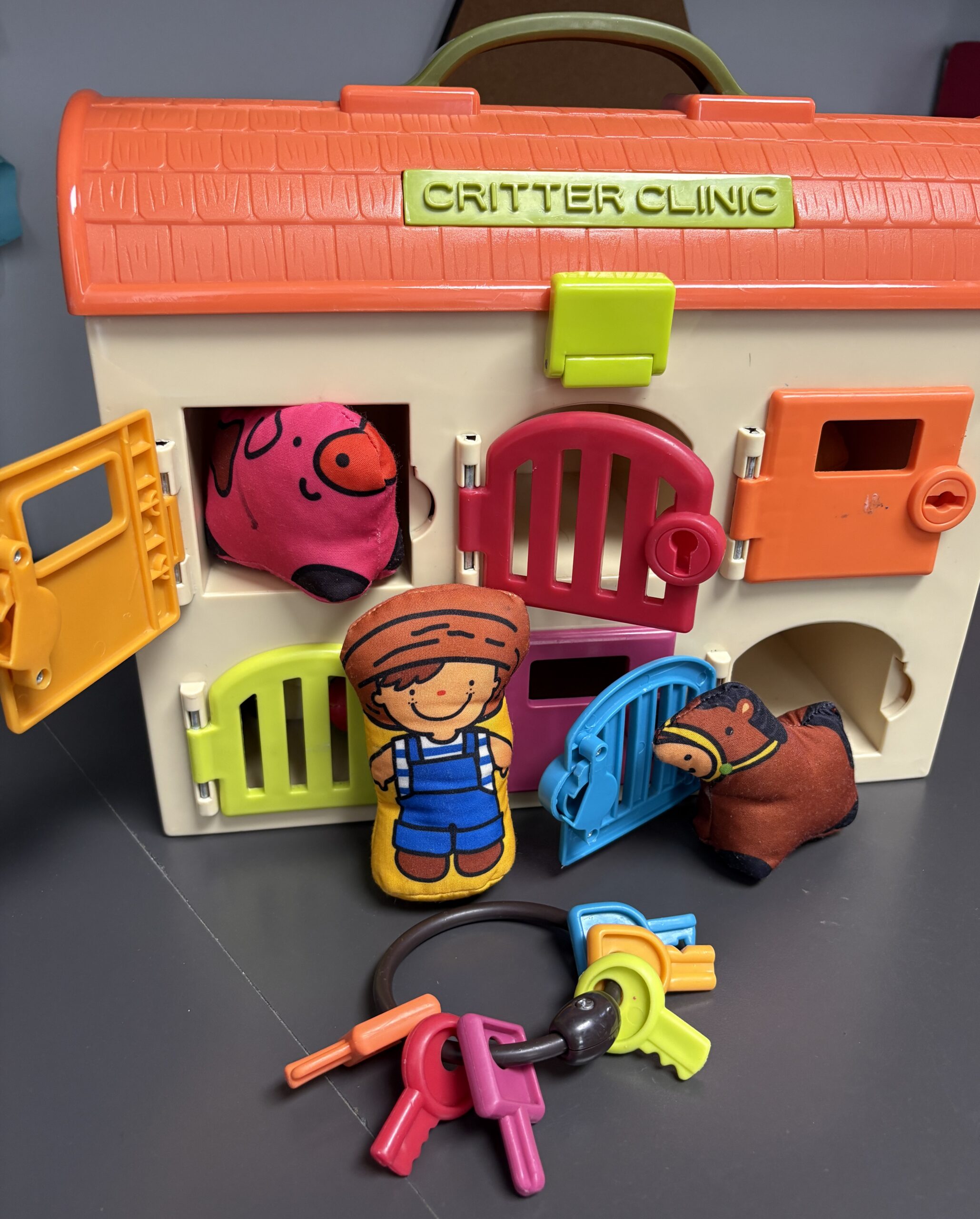
The best toys are often the ones that can be used in many different ways. The Critter Clinic may be designed for pretend veterinary play, but with a little creativity, it can support a wide range of developmental skills.
Here are some simple ways to turn this one toy into multiple play opportunities!
Fine Motor Skills
Picking up animals, manipulating small accessories, opening doors, and using pretend veterinary tools can help strengthen hand muscles and improve grasp and dexterity.
Visual Motor & Visual Perceptual Skills
Have your child find specific animals, match objects, or place items where they belong. These activities encourage visual attention, scanning, matching, and accurate hand placement.
Visual Spatial Awareness
Practice concepts such as in/out, on/under, next to, behind, above/below, and between while moving the animals around the clinic.
Eye-Hand Coordination
Challenge your child to look at an object and guide their hands to place or manipulate it accurately.
Bilateral Coordination
Encourage your child to use both hands together; hold an animal with one hand while using a pretend tool with the other.
Directional Orientation
Practice following directions such as, “Move the puppy to the left,” “Put the cat behind the counter,” or “Move the animal up and then inside.”
Cause-and-Effect Play
For younger children, explore what happens when they open, close, move, or place objects. Narrate the action: “You opened the door, and now the puppy can go inside!”
Motor Planning & Sequencing
Create a simple routine: find the animal → bring it to the clinic → examine it → give treatment → help it feel better. This encourages planning, sequencing, and completing multi-step tasks.
Shared Problem Solving & Frustration Tolerance
When something doesn’t work, pause and problem-solve together: “Hmm…the puppy doesn’t fit there. What could we try?” This gives children opportunities to practice flexibility, persistence, and coping with challenges.
Reciprocal Interaction & Turn-Taking
Take turns being the veterinarian and the pet owner. Practice phrases such as “my turn,” “your turn,” and “all done.” This supports sharing, waiting, social communication, and back-and-forth interaction.
Symbolic & Pretend Play
Let the animals become “patients” with different problems. Your child can pretend to examine them, give medicine, make them comfortable, and send them home. Pretend play encourages imagination and symbolic thinking.
Storytelling
Turn the play into a story! Ask questions like:
- Why did the puppy come to the clinic?
- What does the veterinarian need to do?
- What happens next?
Encourage a simple beginning, middle, and end to support sequencing, language, and narrative skills.
One Toy, Endless Opportunities
The Critter Clinic can be much more than a pretend play toy. With small changes in how you interact with it, you can target motor, visual, cognitive, social, communication, and play skills, all while keeping learning fun and child-led.
The next time your child reaches for a favorite toy, ask yourself: “How many different ways can we play?”
 Physical Therapy